
Baby's first fire
Reflections from my first bushfire a couple of months ago

A couple of months back I attended my first ever bushfire, here on Dja dja wurrung and Wurundjeri woi wurrung Country. Up until that point I hadn’t felt that I could reasonably claim the title of firefighter, despite having completed the basic training. My uniform was still too crisp, with no marks from ash or oil; no smells of sweat or smoke. Although this was only a small fire, I got to put on what still felt like a costume and point a hose at some flames - I’d say that counts.
The day had started as usual with a group of us heading out to do routine works in the forest, this time with bridge maintenance on the agenda. As we drove away from the depot I watched the scenery change from a strip of regional shops to cleared pastures peppered with country homes, skirting through patches of messmate bordering the main road and finally onto the back roads that run along the northern edge of the forest. I tend to do a lot of window gazing - at once amazed, in love and saddened by the patterns and changes in flora and fauna as we move through Country that holds so much memory, and slowly learning to read it in small ways that feel enormous. On this occasion my musings were interrupted by a column of white smoke gently rising through the air like hot breath on a cold morning. We were in a patch of agricultural land, so my assumption was that someone was doing a burn off, though it was a little late in the season for it. Still, I pointed out the window to show my colleague, to which she responded - at least somewhat tongue in cheek - “we should probably go check that out, that’s literally our job”.
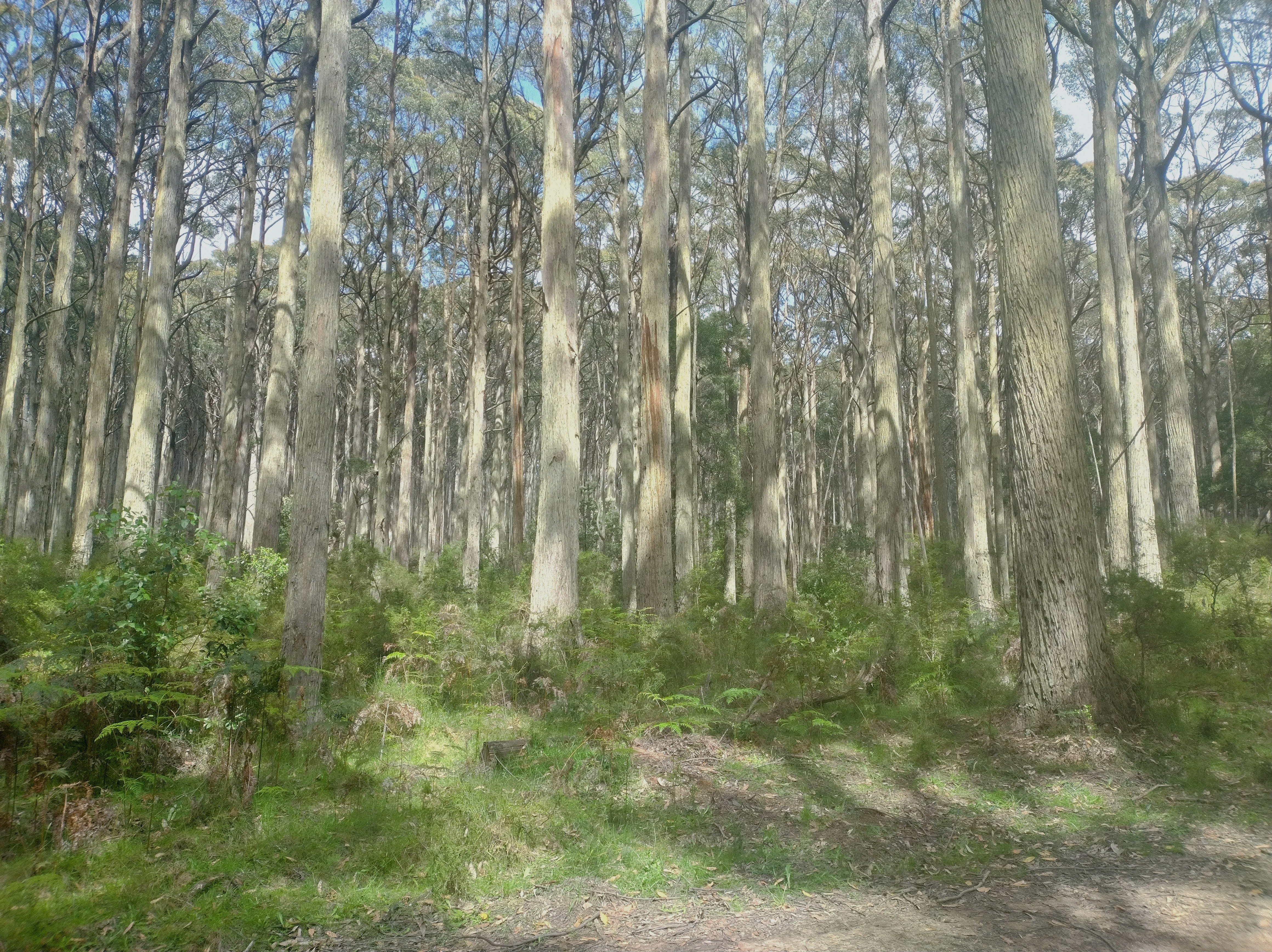
The two of us got on the case and radioed in a second vehicle to help us search for the source of the smoke. We drove the gravel tracks, and I felt alert and alive using all of my senses to search for clues amongst the trees, windows down to smell and hairs on end to feel. The person I was paired up with asked me questions to get me thinking about the characteristics of the smoke and what they might suggest about the potential fire. I observed that the smoke was white, so potentially from a lower intensity flame. The plume was slowly drifting above the tree tops rather than punching upwards quickly or bending over, which suggested to me the overall weather conditions were fairly stable and the winds light (I very much enjoyed this nerdy meteorology crossover). My partner used her fire experience to confirm these hypotheses and predict the fire would likely be trickling through the undergrowth somewhere, through the bracken and the scrub.
As we trundled along bush tracks looking for the source, we could see a thin layer of smoke creeping over the earth and weaving through the trees. Upon crossing paths with the other vehicle, we collectively decided it was time to call for more help. We radioed in the smoke sighting to head office and gave them an approximate area where we suspected the fire to be. They sent up a helicopter to take a look from above, whilst we also got more ground crew on the case. It was a nervous but exciting period of unknown, punctuated by a comical moment when my partner announced it was time to change into our fire fighting gear with the words “now would be a good time to drop your dacks”.
Through a combination of ground crew and helicopters we were able to locate the fire just off a 4WD track. Despite being the first to see the smoke, my partner and I were a bit late to the party because we got stuck down a different route. We were forced to do a 1 million point turn in a bright red fire truck, much to the amusement of the overlooking stringybarks. As we bounced our way closer along the correct track - somewhat rutted and boggy-in-parts - I could glimpse small flashes of flames through the trees. It was real, and looked pretty much as we’d expected based on our smoke informed guesses. By the time we arrived properly on scene, some of the ground crew had walked the perimeter of the fire whilst tracking the path on GPS so they could send the exact size and location of the fire to head office. They’d also used rakehoes to clear some lines of bare earth around parts of the fire to slow its spread. We gathered as a team to form a plan and to clear the area so that the helitak could drop water onto the head of the fire as it tried to make its way up the hill. What surprised me most was how relaxed people were. Yes, we were at a bushfire, but it was a fairly small one and the fire activity was benign thanks to the favorable weather and the fact we got onto it so quickly. We calmly formed a plan whilst we waited for the helitak to finish and kept our eyes peeled for spotting and other changes in fire behavior.
The bulldozer was next in line after the helitak. The operator’s job was to doze a firebreak around the edge of the fire to serve as the control line, which absolutely put the rakehoe lines from earlier to shame. It was amazing to watch the skills of the dozer operator as he neatly circled the fire. At fire fighter school, they taught us that fire requires three things to sustain itself: heat, fuel and oxygen. Once the flames were choked off from fuel, the fire more or less extinguished itself with just a few parts still flaming.
Before the ground crew could get in with the hoses, hazardous tree assessors moved through the fire ground to identify trees that were damaged and dangerous for fire crews to operate around. I keep hearing that fires don’t kill people, trees kill people. Obviously this is a bit facetious, but the fact remains that many injuries to forest firefighters are due to fallen branches and trees. We do what we can to avoid cutting them down, but sometimes it’s just not safe to leave them. In this case, thankfully there were only two trees that needed falling before we could enter the fire ground, though of course a fair few more had been pushed over when the dozer carved its path through the bush. There is an inherent tension in all of this - wanting to protect the forest from burning hot wildfires, but undertaking seemingly destructive activities to do it. Right now I’m holding this tension gently, asking lots of questions and learning as much as I can.
Finally, we were able to get in there to start the process of “blacking out”. This involves, as my colleagues express it, “putting wet stuff on hot stuff”. We drove the dozer track in the 4WDs, getting out periodically to run hoses and extinguish any visible flames, especially anything that we noticed elevated in the trees because this is more likely to result in spotting that crosses the containment line. The equally if not more important job is to find the hotspots that aren’t so obviously on fire. These are often in the stumps and root balls of trees, or in and around smoldering logs. These are the parts that can remain hot for weeks and flare up into a new fire later if we don’t carefully cool them all down. This involves breaking up the heavy fuels with chainsaws and pulaskis, spreading out hot coals with the rakehoe, and dousing these hot spots with water to cool everything down. Crews keep lapping the fire ground over and over until a radius of approximately 30 metres around the edge of the fire is cool to the touch, which in this case was basically the entire area. It was a satisfying process - especially that first moment that I got to hold the hose and point it at flames that were climbing a tree.
We were lucky with the weather on this day - the temperature was mild, there were light winds and it wasn’t too dry. If it had been a hot, dry and windy it would have been a completely different story. As it was, we wrapped things up nicely and had just a few crew members stay late into the night to patrol. That being said, it was weather that had started this fire in the first place via a lightning strike the previous night. One of my colleagues showed me the tree in question and explained how when they are struck by lightning, a messmate eucalypt tends to explode a little bit and throw it’s stringy bark out to the sides, parts of which we could still see hanging in the neighouring trees like a fashion statement. This was easily the most satisfying day of work that I’d ever had, and it allowed me to see a fast forwarded version of current forest fire fighting practices unfolding over the course of the day. On larger and more complex fires each step takes longer and there are more difficulties and considerations along the way.
There is so much more for me to experience and learn, particularly about different approaches to fire and land management. I’m currently reading Fire Country by Victor Steffensen, in which he shares his extensive knowledge and thoughtful perspectives on Indigenous fire and land management practices. This book is giving me both seeds of hope and food for thought in equal measure. Working in the forest means that every day I’m seeing the impacts that colonisation has brought to the landscape through land clearing, mining and unsustainable forms of timber harvesting - either leaving Country bare, or choked up with weeds and too many small trees so that none of them can properly thrive. I’m seeing some of my favourite wildlife, from echidnas to wedge tailed eagles, but also lots of rabbits and foxes, and traces of wild pigs and deer. People here understandably feel very strongly about the forest, and generally fall into one of two camps - the “I should be free to do whatever I want in here” people and the “we should protect nature and leave it alone” people. Both perspectives seem to be steeped in the colonial assumption of separation and disconnection between people and country. Both Victor’s book and the Galk-galk Dhelkunya Forest Gardening Strategy produced by DJARRA point to some sort of middle ground - where people are actively influencing and managing the land, people as an intrinsic part of the landscape, but in a way that is deeply rooted in connection and respect.
I hope we live to see the benefits as more First Nations folks get back on Country to practice culture and land management, with support from white fellas along the way where it’s needed. You can donate to Firesticks to help support the vital work of building the capacity of cultural fire practitioners, or check out more resources, services and events from DJAARA. Right now, there are many parts of the state that are actively under threat from or grieving the results of out of control bushfires - it’s more important than ever that we combine our strengths with humility, build mutual understanding and most importantly follow the lead of First Nations people to act in the best interests of Country and people.
What have you always wondered about fire fighting? Or how weather influences fires? Hit me up with questions, or to organise a group session if you’d like to hear more.
What does "spotting" mean in a fire context?